Přepis je upravený pomocí AI kvůli lepší čitelnosti: bez výplňových slov a opakování, s učesanými větami. Nejde o doslovný záznam. Místa, kterým v záznamu nebylo rozumět, označuje […]. Přednáška je v angličtině.
Intro 00:00
Moderator
So our next speaker is a program manager for the Google Developer Groups program and other developer communities at Google. He co-founded GDG and helped scale it into one of the largest meetup communities. Daniel was also at the launch of the now global Google Business Groups and Google Educator Groups and was the lead of several online communities. He has a background in sociology, management, and software engineering. Please give a big CMX welcome to Daniel Franc!
Daniel Franc
Thank you very much. I have to say, this is the best treatment for jet lag I've ever gotten. My energy is back. And I have it every day that I travel to the US. That's pretty awesome. Thank you for the warm welcome.
By the way, I totally understand the table discussions. I was almost late. David was almost late. You were sitting at the tables talking with other folks. So I totally encourage you to share with others. I learned so many things here today just from random encounters. I came from Prague. There was one lady I met yesterday at the speakers' dinner, and she's also from Prague. It's pretty unusual to meet people not just from Europe, but from your little tiny country in Central Europe.
And yes, I'm part of Google, the search engine and a couple of other things. Our mission is to organize the world's information, and developers are a great way to enable the information to come to people. So I'm in developer relations, and one of the core things that we do is working with communities. David teased you that I will be talking about ants.
Yes, I will be talking about ants a little bit. By the way, it may be a sad talk, I have to warn you. Disclaimer: some of the myths that you may believe are true about ants, like the childhood myths, will probably fall today. So that's a little bit of a warning. But don't worry, we'll also be speaking about people. We'll be speaking about what we can learn from natural systems, represented by the ant colonies, to build communities, and not just large or huge communities, but even small ones. So we'll look at that. And at the end, I will try to distill it into about four characteristics that I believe can be used in different communities. As David said, I've been involved in many, many communities. And I believe that, yes, the ants can be great teachers.
About the GDGs 02:48
Daniel Franc
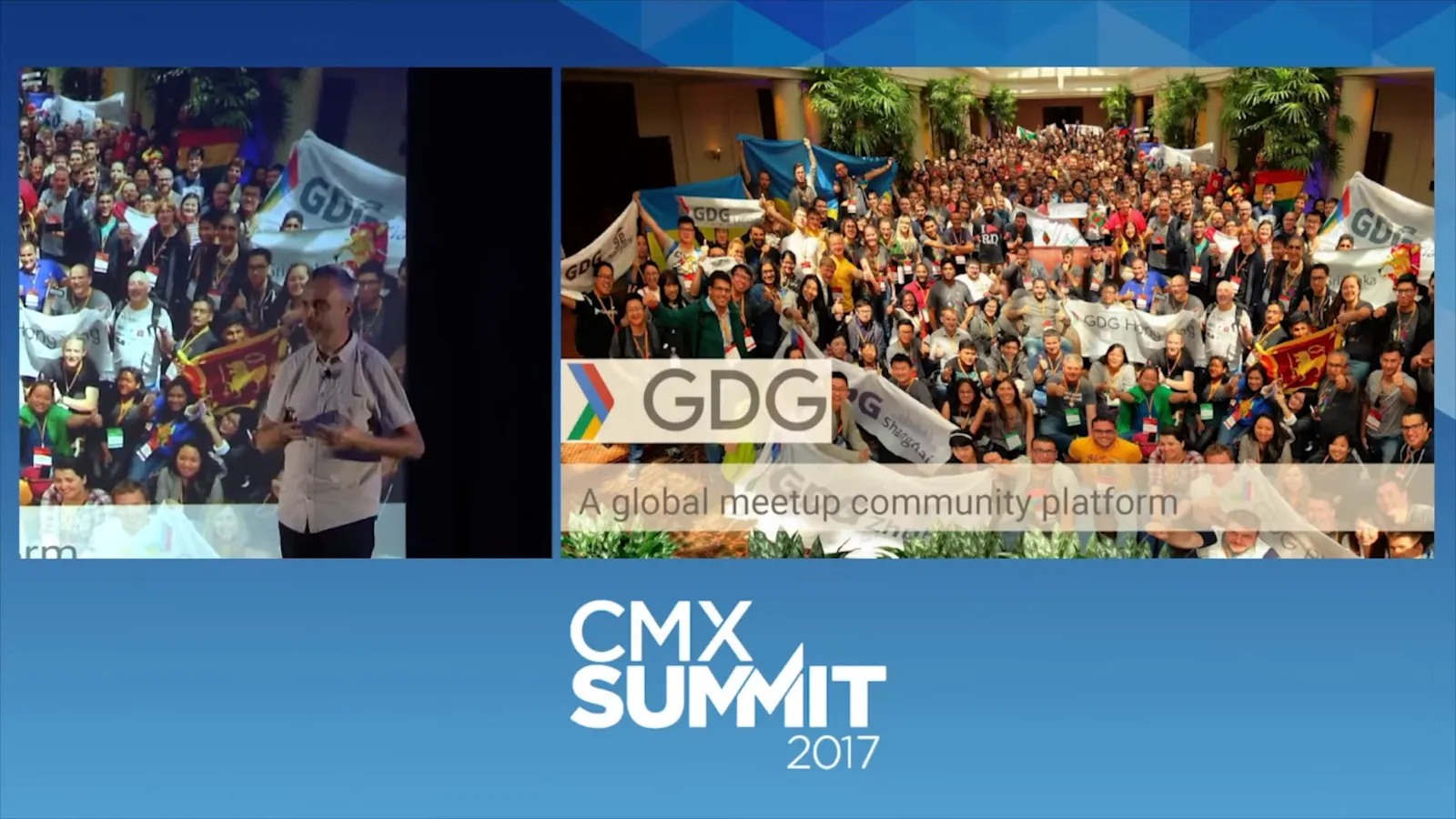
But first, a little bit about the GDGs. It was quite amazing, I even met people here who said, yeah, I was at a GDG meetup. So it's a meetup community. It's not an online community. That's the important part. What do GDGs do? Organizers organize meetups. There are about 20 meetups every day all around the world. At the meetups, people get together. They have a speaker. They have a beer afterwards in my country, tea in the Middle East. They have wine before and after the event if they are in Italy. But most importantly, they get together.
We as Google are partners to them. So we don't technically own GDGs. We don't prescribe to them what to do. We like to see ourselves and the GDGs as partners. Why do we do that? For us, the biggest value really lies in helping developers, making the world's information universally accessible. We know that there is no way that we at Google can teach every developer the latest technologies. Android O was released a month ago. How do we get the word out? It's basically developers talking to developers. So that's why we really love working with GDGs.
The DNA 03:56
Daniel Franc
This November, we'll have the 10-year anniversary of the first meetup that I happened to run in Prague. The first meetup was a great success. I'm kidding. The first meetup was a complete disaster. So those of you who are starting communities, don't be put off by the meetup. We had two speakers, six hostesses, and four attendees. My co-founder and I were looking at each other, thinking, well, maybe this Google community wasn't the best idea after all. But we persevered.
And what we have now is 10 years of growth, but the DNA is still the same. So many things changed, we changed a lot of things, but the DNA is still the same, meaning it's volunteer-run. It's not a marketing or sales tool, because of the very early days. I noticed in the CMX Facebook conversation that lots of people were asking how to start a community. So I would say whatever you put in the DNA, even at the first meetup, will stay there 10 years later. And we see that in the GDG world.
Where is the DNA 05:00
Daniel Franc
It's massive now. I would say it's everywhere but Antarctica, that's still untaken. That's a challenge I still have. So if somebody has some scientist friends who would like to start a little meetup community base, we can do that. Other than that, it's anywhere from Polynesia to South America, the other way around the globe.
Our core community that we are working with are the community organizers. So technically, what I do in program management is work with these community organizers, and I want to make them successful so that they can build their local communities. When it comes to membership, we don't really track that. […] Our membership is very ad hoc. Whoever comes to the meetup is a temporary member of the GDG community. Still, there are about half a million people who say they are members of GDGs on meetup.com.
Local Focus 05:57
Daniel Franc
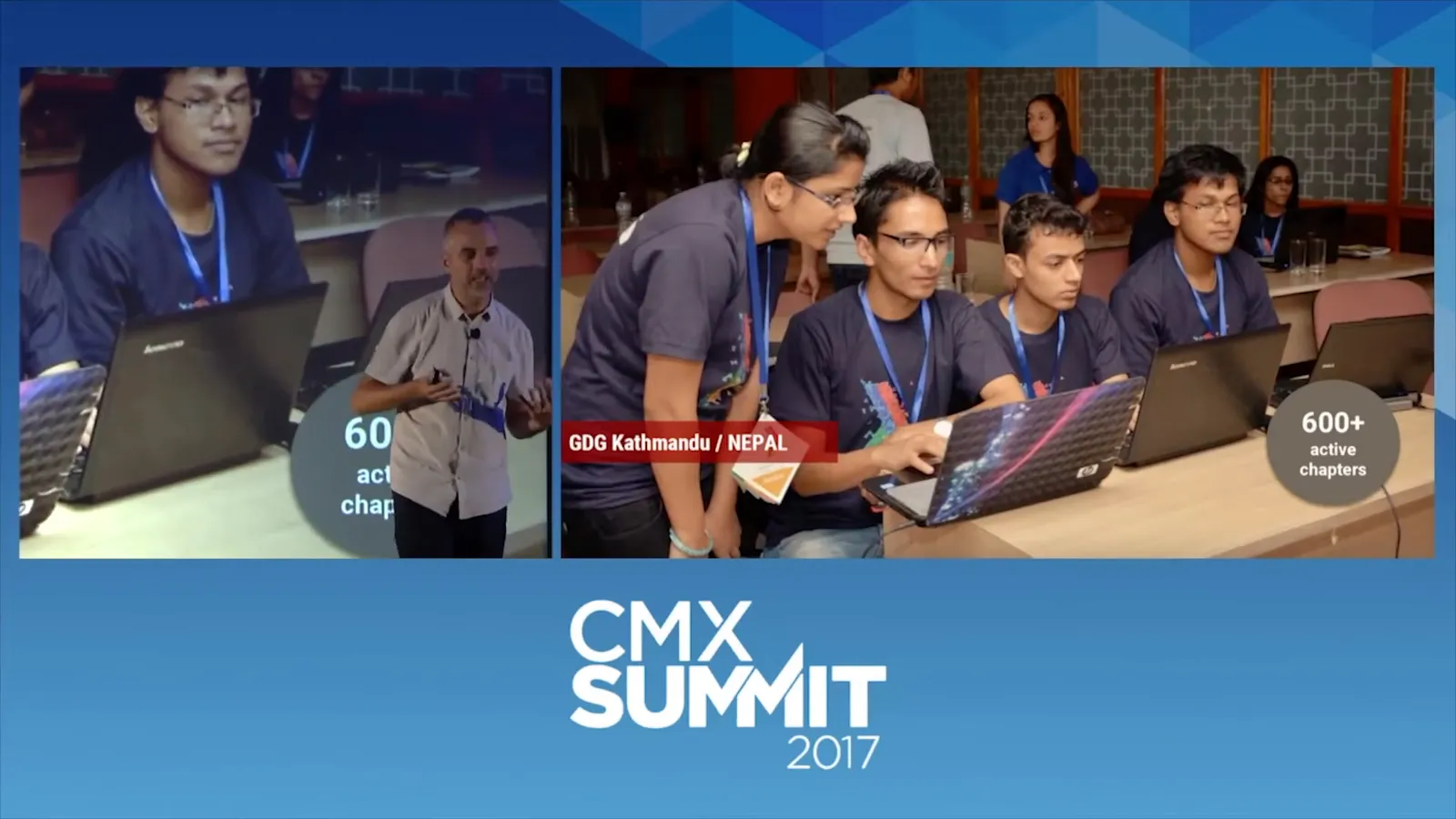
It's everywhere. This is a community in Kathmandu, Nepal. Our main focus is to be really local, I would say hyper-local. You probably know the saying, act locally, think globally, right? For me, I would say it's act locally and think locally. I mean, these people in Kathmandu, I have no idea how they can adapt the Google Developer Platform to the needs of developers in Nepal. They know. So I am not the one who will tell them how they should adapt the message or how they should show each other how to work; they will figure it out.
So our main focus, and that's one of the things that I truly believe contributed to the growth we have seen in the past 10 years, is a very local focus. You may ask, how can we create a global movement from very locally acting communities? And this is where the ants will come into play. So let's hold on to that for a little bit.
Community Events 06:59
Daniel Franc
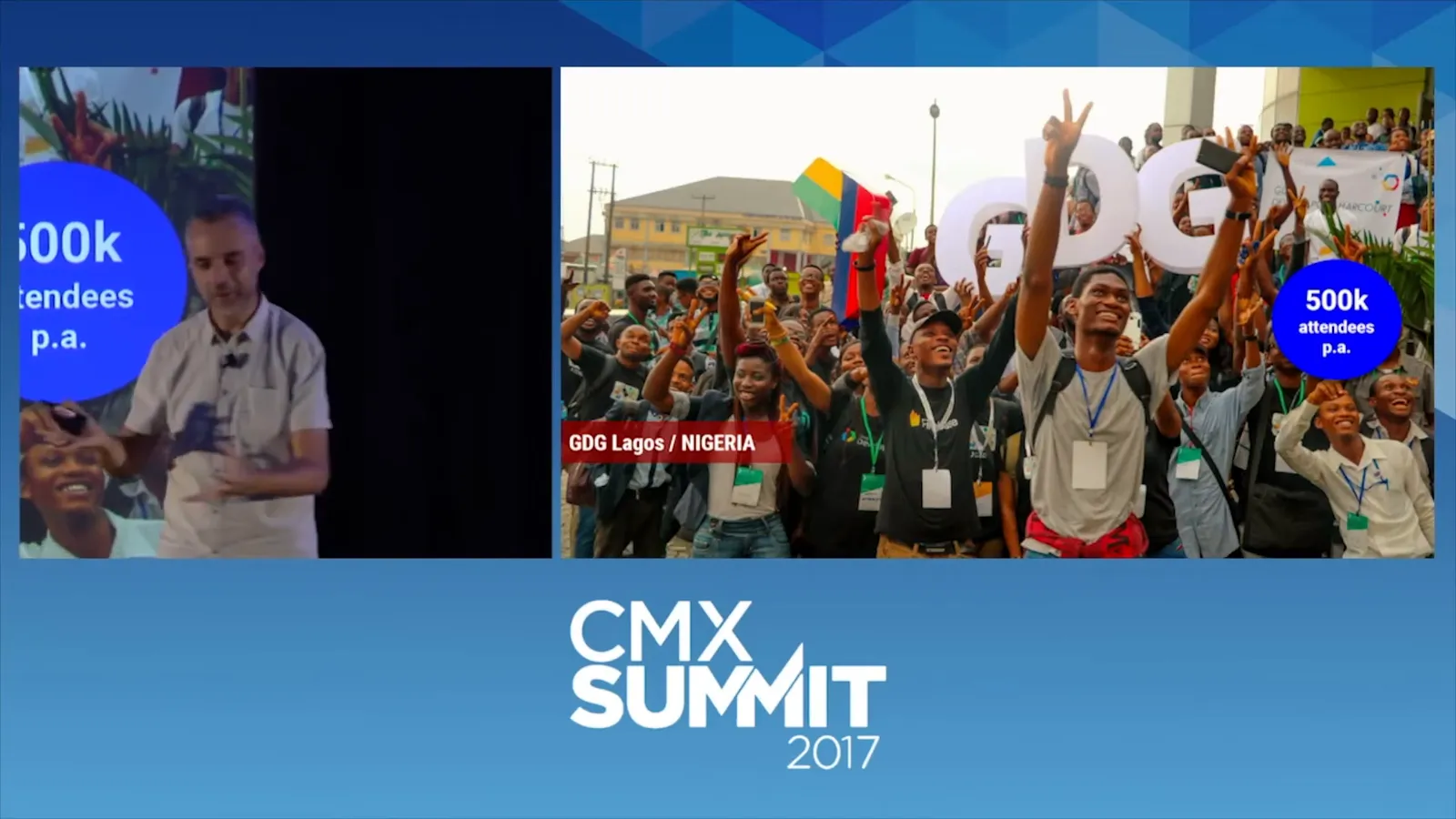
Now, we are also in the United States, not just Nepal. Together, these communities around the world create about 7,000 events, which translates to roughly 20 events every day. They are volunteers. So they do it for the reasons that some of the speakers mentioned here today: for learning, for connecting, for getting better, for opening up their opportunities. We create a platform for them so that they can find this success. So the platform is a very important part.
Today and tomorrow, we have a large summit of all the Sub-Saharan organizers in Nairobi. I wish this was live-streamed […]. They are really active. Sub-Saharan Africa is a fantastic environment for building communities. So if you are looking at a global community, go to Sub-Saharan Africa. Kenya, Nigeria, Côte d'Ivoire, all these countries are really active. But together, they reach the Africans and the Americans and the Nepalese, about 500,000 people, half a million developers. I mean, it's not like the 100 million members of some of the large online communities. But mind you, these people are meeting face to face. They experience something physically. They get to speak to each other. They experience events like the one we are having today, just community-organized. For us, there is huge value in these face-to-face encounters.
“So I am not the one who will tell them how they should adapt the message or how they should show each other how to work; they will figure it out.”
Daniel Franc
DevFest 08:29
Daniel Franc
DevFest is one of the, I would say, flagships of the activities that we do, or that we do together with GDGs. It's a one-day conference. The average number of attendees is about 200. Some of them have 1,000, some of them have 50. But they meet for the whole day, again, like we are meeting today, and they talk about stuff that is important for developers. Again, they are all volunteers. I have seen DevFests where the organizer group, like here in Algeria, was almost larger than the community. People love doing DevFests as organizers. There is some adrenaline you get from organizing an event. I guess that's why David is doing these conferences, right? It's the rush. So again, we want to support these people to have this adrenaline rush and this success.
How do we grow 09:16
Daniel Franc
This is the map of how it looks now. You see it's pretty covered. So when we look at how we grow, how we spend the next 10 years building this community, it's not really about how we build communities in the Sahara or, yes, Antarctica, but how to keep this movement evolving. How do we keep improving? How do we keep the organizers happier and more empowered to do things? As David said, I have all kinds of degrees, but none of them taught me that. How do you work with a global human structure like this?
This is from India, from Goa. I was observing these ants, and I swear I didn't have any beer, but I totally felt like I was looking at my communities: the little chapters, the movement, the chaos, the unpredictability. I was thinking, yes, this is ants. What can we learn from ants? But all that I knew about ants was from popular literature, right?
Indian Ants 10:15
Daniel Franc
And I got a feeling that that's probably not what I should take as an inspiration. I mean, the Indian ants were not talking at all. […] So I started studying ants. And it fit a little bit with the study of complex adaptive systems I did, which is very theoretical. It's like physics and chemistry and mathematics combined. I like that ants are like a complex adaptive system in life.
So I started reading books. Eventually, I ended up at Stanford, Stanford University. When you say Stanford, most of the people in my team see computer science. But I went to the School of Biology, where one of the leading ant researchers in the world is, Professor Gordon. I mean, she is incredible. Do you know what this is? This is from her office, this little box. This is a spaceship for ants. She says, I'm shooting ants into space with NASA in this. So she really knows a thing or two about ants. And we discussed, and the result was that, yes, everything that we know about ants is a myth.
Mythbusting slide 11:24
Daniel Franc
So now here is the myth-busting slide I want to show you. Look at this. The white things are at least what I believed about ants. The red things are the reality, and we have it researched, backed by Professor Gordon and her books and everybody else. So if you look to the left, at the white ones, it's almost like a traditional company, a traditional corporation. They have a CEO, everybody has a role to play, there are plans and a waterfall that everybody is following. I knew this is not how you want to build a community.
And then there is the uncomfortable truth. For example, the queen. I very much missed, and I will miss, the queen. It turns out that even the term queen was invented in the 17th century to justify to people why they need to obey the king and the queen. And actually, what we know about ants is largely a political thing.
I grew up in communism. In communism, ants were a big thing, because the regime was telling us: you have to work and you have to have discipline, like the ants. There were books for kids about this that I loved. It's gone. Of the ants, 30 of them are doing nothing. I asked Professor Gordon: but you know, the ants, at least everybody does the same thing, they are like simple biological engines. And she says, the ants can get so confused, or lazy, or bored. […], and there are ants that walk the other way. But they have alignment.
But still, if you look at the red things, it's really, at least, how the GDGs function. We have people who just do nothing, who wait. And why not? We have a very flat structure, […] bosses. The whole system is unpredictable. So the question was, how can we learn from this? Because this is nice, but I need to convert it into practice. Let me skip this slide and go here.
Chaos in order 13:29
Daniel Franc
So there are two models which are useful. If you use the search engine thingy that David mentioned, you can look up the word chaord. Does anybody know what that means? It's from two words. Chaos and order, exactly. Chaos is a big term. There are even terms like chaordic organizations. So maybe if you get frustrated in your company that there is a little bit of chaos, maybe the company is just chaordic: there is some chaos and some order. One theory says that if you sort of dance on the edge between chaos and order, you can achieve incredible results by giving people the freedom to do whatever they want, but giving them some structure to function in. And I could build my whole presentation just about chaord.
But a little bit more guiding is complex adaptive system theory. Again, look it up. I will not bore you with theories. Actually, I did that about three years ago at a conference for community managers in London. There are about 16 parameters of complex adaptive systems. I mean, they're beautiful. If you adapt every single one of them, the community will work. But that was long and boring. So there are four. There are four principles I want to share with you.
Agents 14:44
Daniel Franc
“You need to have the right people. This is the alpha and omega, nothing else really matters.”
Daniel Franc
Number one is all about the, it's called agents in CAS theory. You need to have the right people. This is the alpha and omega, nothing else really matters. For the community, and again, we have heard it so many times here today, you need people who want to belong, who want to find a tribe. Somebody asked me yesterday: developers, engineers, they really want to talk to each other? Well, actually, they do. Meetup communities are the number one source of their learning. They want to find their tribe. Second, they want to get better. So you want people who want to find out from other people what they can do. And finally, you want people who feel like fighting for a higher cause, or making a contribution. I believe there are some people from Mozilla communities with us today. Mozilla is fantastic for that. Mozilla is almost a religion, and a big pardon to the Mozilla people, but I see this as a compliment. There is such a big cause for this community.
Once you have the right people, we have to build the ant colony for them. We have to ensure the DNA sort of guides people in what to do, because there is no boss telling them, there is no queen, nobody to tell them what to do. So it's the culture that needs to guide them. How do I make a decision about this event? How do I make a decision about working with other organizers? So for us as partners, as the platform providers, you would say, we really care about making sure that the culture is maintained, the brand of the community. When you say Google Developer Groups, developers and software engineers pretty much know what that means. They know what it means to organize a meetup. And that's really important, because you want the brand to be self-selective. There is nothing like interviews. The community is very open to the organizers.
You want to ensure that they still get value from that. By the way, this word, fun, I don't hear it so much at this conference today. It's a little bit surprising, because, as I know many of you personally, your communities are so much about fun. We […] have to be ashamed of the word fun. Without fun, people will not function in your communities. Fun is a super important piece. People want to get value in a fun environment. Again, there are so many talks and examples from the political parties throughout. I will skip it.
And finally, the ants have some resources. In the same way, your community organizers or community members have to know: how do I get my resources? How do I collaborate with others? What are the expectations of the resource provider? So we as Google, for example, ask our organizers to send us a little bit of information every month about the events they did. So, for example, that's the system.
So this is the first thing. Now we put our little ants into the colony. We need to do three more things with them.
Communication 17:43
Daniel Franc
We need to let them connect and interact all the time. The ants are communicating every 20 seconds. For us in the communities, people talk a lot. Sometimes community managers get frustrated. Well, nature teaches us that the more the merrier, actually, because it's from the interactions that you get emergence, which we'll be talking about at the end.
“Well, nature teaches us that the more the merrier, actually, because it's from the interactions that you get emergence, which we'll be talking about at the end.”
Daniel Franc
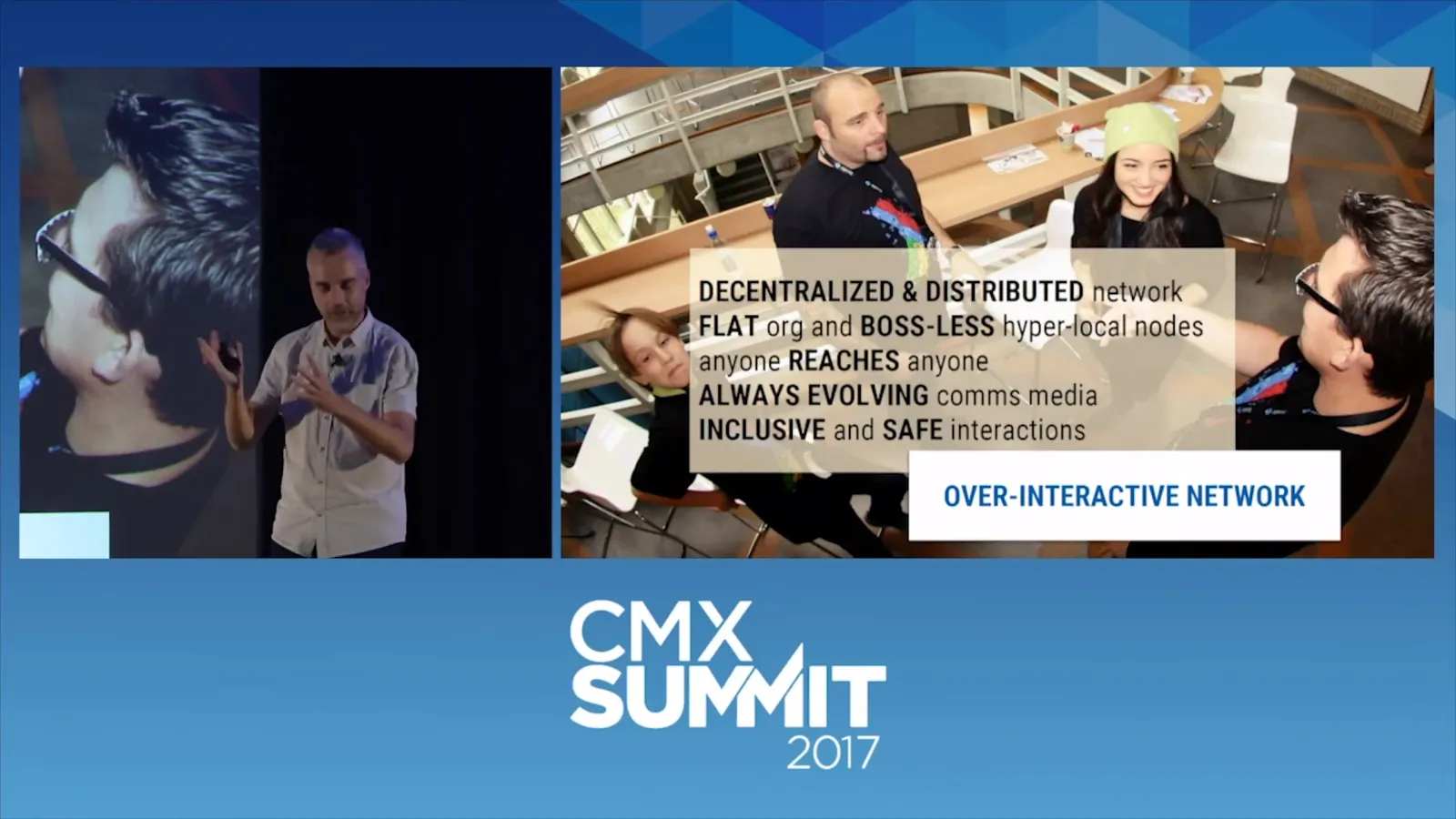
Two things are important for this communication. One, there must be no vertical barriers: bosses and middle management and upper management and whatever structure. Sometimes you have countries where this is important, but even if they set up some structure like this, we really try to make sure that the structure is very fluid. The same goes for peer-to-peer communication. We try to make it possible for everyone to talk to everyone. Yes, it's lots of chaos, here we are on the […] part. But again, it's very important. And finally, people must feel comfortable and safe in these interactions. So we put a huge value on making sure that people feel included, people feel safe, people feel trusted, people feel trusting. So that's very important.
Action 19:04
Daniel Franc
OK, so we have the agents, or ants, or organizers. We have them interacting. So what happens next? Next is the action, and that's really what matters. These are some Czech organizers. They do a barcamp and conference every three months to talk about what they experienced in the past three months. There are actually about 60 of them; this is just one of the groups. And they are very open. They talk about what didn't go right. Actually, they have an annual award, the fail of the year. It's a very prestigious award. The guy who won it three years ago became the country mentor or coordinator the next year. So when you win this award, that means you really push the envelope. You risk. You try. You go ahead. So you need to be really open here and let people, like the ants… Like Professor Gordon says, yeah, 20% of the activities are going to be a disaster. Yes.
Emergence 19:51
Daniel Franc
And finally, you want to see emergence. For us as partners, this is very important. We want to see chapters emerging. We want to see new organizers emerging. We want to see new events emerging. I was mentioning DevFest. DevFest is an activity that the community pretty much invented and that emerged, and we highlighted it and let the other organizers join. Sometimes with branded communities, the partners really step in and try to sell stuff or prescribe to the communities. My role at Google is to make sure this doesn't happen, that we really treat the GDGs as our partners. We may seed. We may give them content to use. We may offer them an activity, an event, a format to use. But that's just an offer. That's the seeding.
“My role at Google is to make sure this doesn't happen, that we really treat the GDGs as our partners.”
Daniel Franc
So, ladies and gentlemen, what we can learn from ants can, I believe, be summarized in this one slide. I looked at it so many times that I felt it's trivial. But then I decided, yes, let's look at it, hoping that it's trivial. And then think: how do we get the right people and give them the culture and the system to be successful, whatever success means for them? How do we make them reflect, give feedback and act very freely in a super fluid network, which leads to emergence? So I would say the whole secret of our success lies in this unfortunately trivial slide, which is fortunately easy to adopt. Thank you very much. Enjoy the rest of your day.